
In 2027, The National Running Show will mark its 10th anniversary and as part of the celebrations we are featuring an in-depth series with key brands - Miles & Milestones: 10 questions for running brand success.
“For us, The National Running Show is the most important running event on the calendar”.
Nick Beresford, CEO Enertor.
In this Q&A, we sit down with CEO Nick Beresford to explore Enertor, a science-backed insole designed to revolutionise your running stride. By absorbing 51% of impact and returning energy to your step, these trusted, elite-level insoles are clinically proven to slash injury risk, helping you stay pain-free and push your limits.
1. Could you firstly take us back to the beginning, what was the specific 'spark' or gap in the market that initiated the brand?
The spark came from elite sport. For years we'd been working with the best athletes and teams in the world: multiple Olympic champions, multiple Tour de France winners, the best cricketers in the world, Premier League footballers, NBA stars, and the British Army, which ran a clinical trial showing a 66% reduction in lower limb injury risk using our technology. We were watching this elite group benefit from the science, and it became impossible to ignore the question: why shouldn't every runner have access to this? Enertor was born to take what the world's best had been quietly relying on and put it into the hands of everyday runners.
2. How has that original purpose evolved or shifted to meet the needs of today's runners?
The mission hasn't shifted, only the language has. We exist to help runners, from elite athletes to people doing their first 5k, stay running and improve their performance. We call it 'helping them achieve their impossible'. Whether your impossible is breaking three hours at the marathon or simply running pain free again after years of injury, the goal is the same.
3. In scaling from a small team to a global player, what was the biggest challenge in maintaining a consistent culture and quality across the entire supply chain?
Culture is a strange thing because it evolves whether you steer it or not. Ours is built on taking big risks and refusing to settle, which is what 'achieve the impossible' really means internally. The hardest part of scale has been on the supply chain side. There have been moments where demand outstripped our ability to fulfil, and that hurts both the customer and the brand. We've invested heavily over the last couple of years in better systems and stronger supply partnerships, and we now have the foundations to scale properly.
4. How did you come up with the 'egg test' and how successful has that been at demonstrating the shock-absorption capabilities?
We wanted something that communicated impact protection in a single moment, without anyone needing to read a spec sheet. We tried light bulbs, Christmas baubles, even bowling balls. We kept coming back to the egg, because nothing is more visually striking than dropping a heavy weight onto an egg and watching it survive. It's a two second demonstration that does the work of a fifty-page lab report.
5. Usain Bolt has been with Enertor for many years, how did that come about and what is his level of involvement?
Usain has been with us since the start of the Enertor journey. He came on board because he genuinely loved the technology and committed not just as an ambassador but as an investor in the business. That dual commitment matters. He has stayed with us through every chapter since, and we remain very grateful for his support and partnership today.
6. What would you say is the biggest hurdle for a British-based brand when scaling into competitive markets globally?
Making yourself heard. Running and sports footwear is one of the most competitive consumer categories in the world, and the biggest players have R&D budgets and marketing budgets that we can't match pound for pound. Our route through that has been to compete on what we are genuinely better at: the science, the data, the proprietary technology, and the proof. Superior product wins over time, even if it takes longer to break through.
7. How do your bespoke medical orthotics for conditions like osteoarthritis differ technologically from the retail running insoles?
The bespoke orthotics are tailored to a specific person, allowing us to make precise adjustments for their biomechanics and condition. There's a small group, roughly 10% of people, who genuinely need that level of personalisation.
For the other 90%, our retail product is engineered using data from over 150,000 athletes, and built on our proprietary PX1 formula, which delivers twice the shock absorption per millimetre of the leading competitors. Combined with biomechanical design that reduces injury risk and supports conditions like osteoarthritis, it's why we have thousands of 5-star reviews and continue to be specified by the British Army.
8. Your research with the British Military and the University of Melbourne showed a 66% reduction in injury risk. How has this specific success metric changed your standing with professional sports teams and medical providers?
It was a landmark study. Not just because of the 66% figure, but because it had the largest sample size of any study ever conducted in this category. It validated something we and our clinical partners had been demonstrating in smaller studies for years, but at a scale and with an authority that opens doors. Sports teams and medical providers see a lot of products making claims. Independent research at this level is a different category of evidence, and it's been an enormous help to the business.
9. Why is exhibiting at The National Running Show important to you?
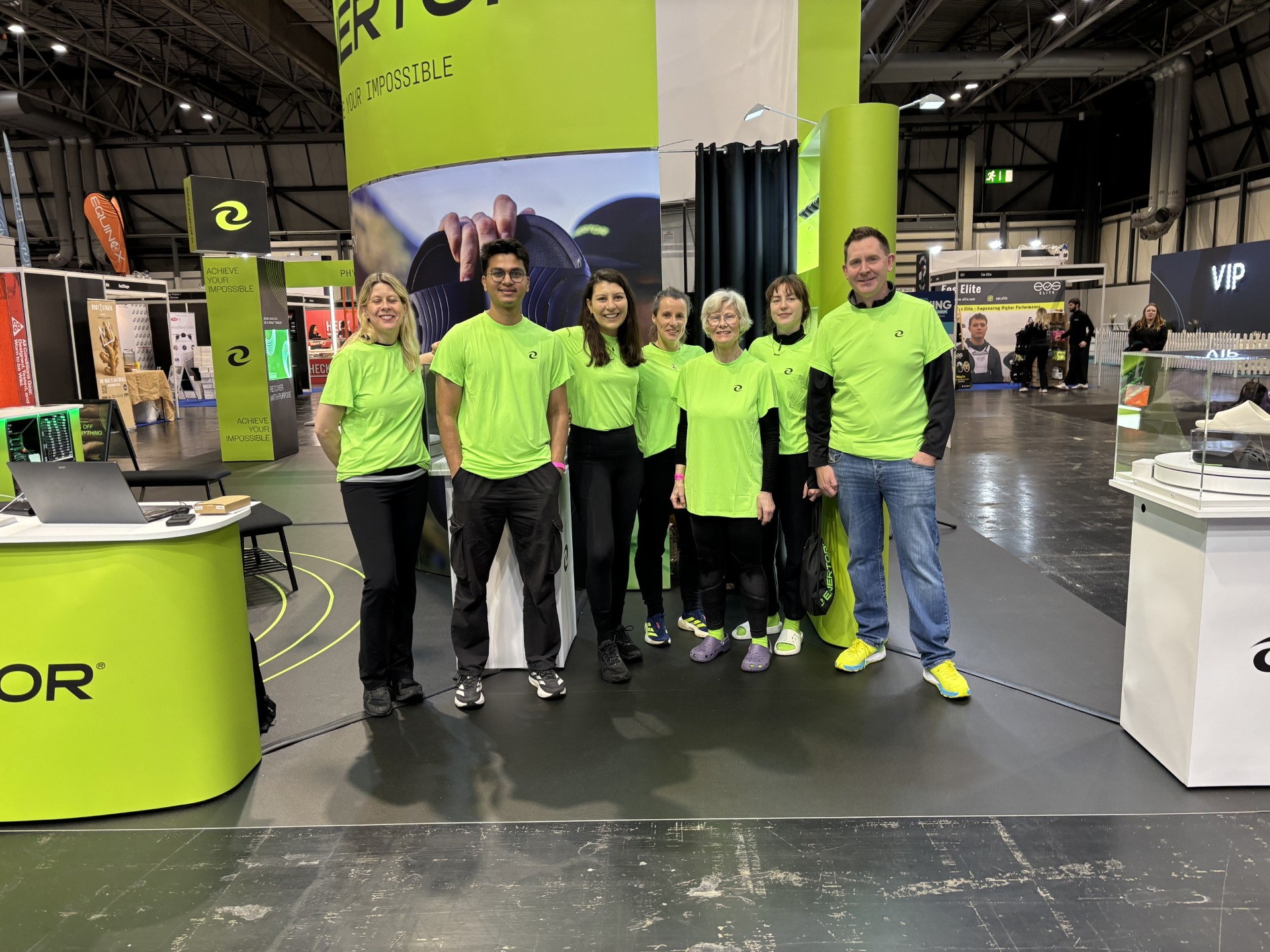
For us, The National Running Show is the most important running event on the calendar. It's where the most engaged runners in the country come together, not just to enjoy the show but to learn from the experts, see new technology, and try new products. We've found that exhibiting at race events themselves often misses the moment, runners are either focused on their race or eager to get home afterwards. The National Running Show is the opposite of that. People are there to discover, to talk, and to buy, which makes it the perfect environment for a brand like ours.
10. If you are happy to share, what are Enertor's short and/or long-term development plans?
We have a strong innovation pipeline. New patents are being granted, others are about to be filed, and we're continuing to invest heavily in proprietary technology that's properly tested and properly proven.
The Recovery Slides we launched at The National Running Show are a good example: nearly five years of development, independent testing showing measurable improvement in post run recovery, and the product sold out almost immediately. Short term, we're scaling the Recovery Slides internationally and expanding the recovery range. Longer term, we are a British brand with global ambitions: the goal is to become the world's leading brand in biomechanical sports recovery and injury prevention, by continuing to bring scientifically backed technology that genuinely helps people perform and stay healthy.