
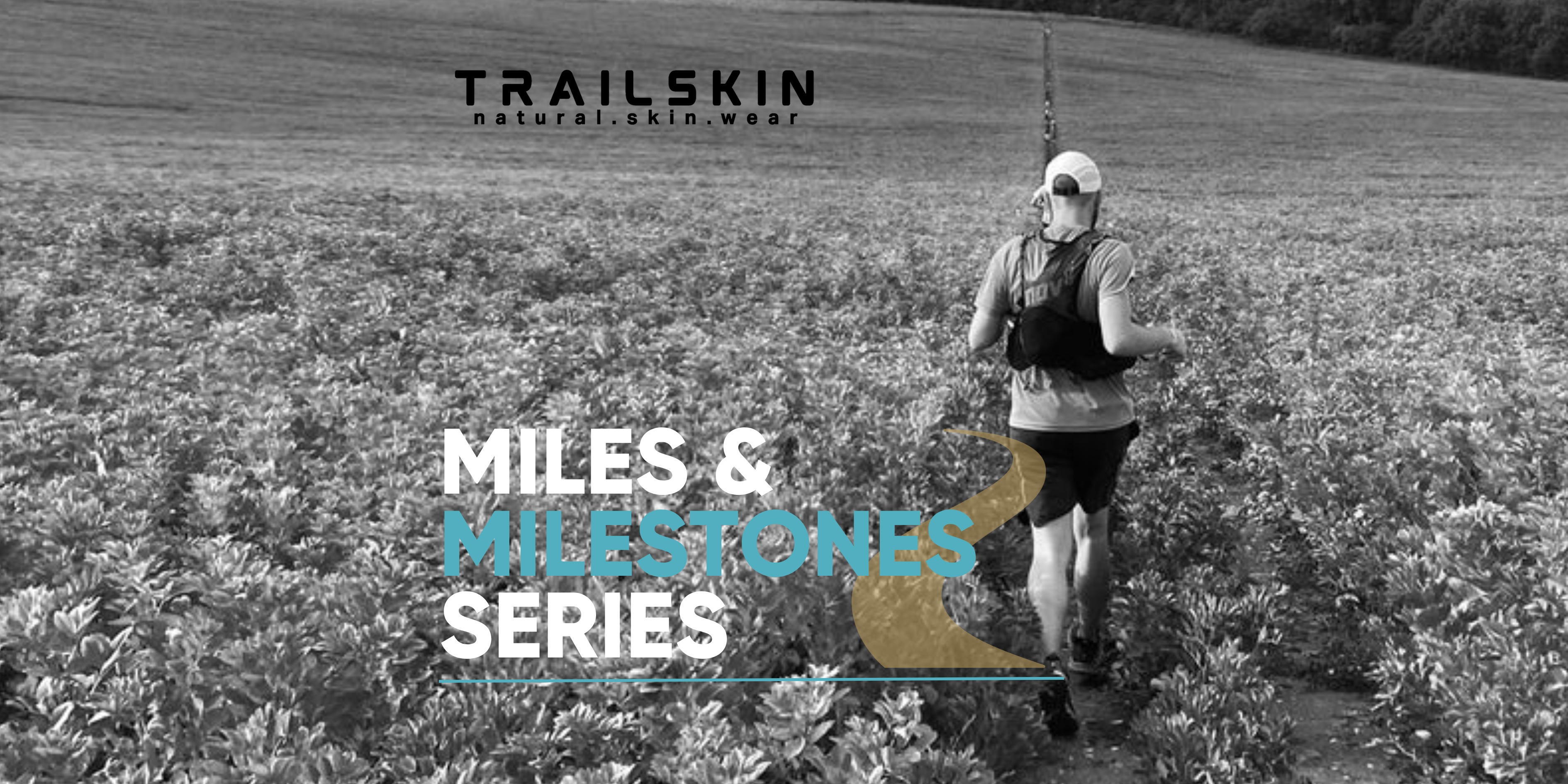
In 2027, The National Running Show will mark its 10th anniversary and as part of the celebrations we are featuring an in-depth series with key brands - Miles & Milestones: 10 questions for running brand success.
"The National Running Show is consistently one of the most valuable dates in our calendar, not just commercially but culturally. Having that community physically present, people who train in our products, race in them, genuinely believe in what we're building, changes the quality of every conversation we have at the Show. It's not a sales stand. It's a gathering point."
Dave Johnson – Founder, TrailSkin
Built for the unpredictable demands of the off-road runner, TrailSkin delivers high-performance gear designed to withstand the harshest elements without sacrificing comfort or speed. Whether you are tackling muddy single tracks or steep alpine climbs, this brand provides the durable, second-skin protection you need to push your limits on the trail.
We sat down with TrailSkin Founder Dave Johnson to discuss the brand’s evolution, rigorous product design, and what to expect at The National Running Show 2027.
1. What was the specific 'make or break' moment during the Arc of Attrition (100 miles) where you realised, 'I can't just buy something off the shelf to fix this'?
The honest answer is that the 'break' moment didn't come at the Arc, it came earlier, at the North Coast 110 by Climb South West. A wet 110km on the North Devon coast path, back in 2021. It's a brilliant race, and a brutal one, the kind of day, well night really as it starts at 8.30pm, where the weather makes every decision for you and your feet are wet for hours at a time.
Somewhere deep into that event, I reached for the products I'd been relying on, the type of thing you'd find in any running shop, and realised they simply weren't built for this. They were road runner products. Designed for 90 minutes, maybe a parkrun in the drizzle. Not for 12-plus hours of continuous wet immersion on technical coastal terrain. The barrier broke down. The skin paid for it. And the only real answer the market had was to reapply every few hours and hope for the best.
That question - why does nothing exist that's designed for this? - became the founding brief for TrailSkin. The Arc of Attrition came later and became one of the proving grounds for the early formulas. But it was the North Coast 110 that broke the spell and made it clear that if we wanted the right product, we were going to have to build it ourselves.
2. Your brand story emphasises that you are a 'family of adventurers' rather than just a faceless, technical company. How do you maintain that community feel as you grow?
It's not a positioning, it's literally the origin story. In the summer of 2024, my family and I were on an adventure in New Zealand. At that point we had final product versions ready, months of formulation work behind us, real-world testing done. What we didn't have was a name, or a company. It was somewhere on that trip, surrounded by extraordinary landscape, with the family along for the ride as they always are, that TrailSkin came into being. Not in a boardroom. Not with a branding agency. On a family adventure on the other side of the world. Waking up one morning with the name in my head.
That's the culture, and it's baked in from day one. TrailSkin wasn't built in a lab by people who read studies about athletes. It was built on trails, at checkpoints, in the middle of the night, by someone who'd made the mistakes themselves, with a family that understood why those miles mattered. That story doesn't go away as we grow. If anything, it gets more important as a reminder of what we're supposed to be.
In practice, it means our ambassadors aren't influencers, they're runners who genuinely use the products in conditions that would embarrass most brands. It means when someone emails us after a race, I write back personally. It means we're on the start line with you, not watching from the car park. The community feel isn't a marketing decision; it's the only way we know how to operate. We want Fans, not customers.
3. You often say, 'The first mile is always the hardest.' How does that manifest in your brand's mission today?
The first mile is the hardest because your mind is already telling you all the reasons you won't finish. And if your mind is doing that at mile one, it's easier, much easier, to never start at all. Most people don't fail at the finish line. They fail at the front door. The discomfort of beginning, the uncertainty of not knowing if you're capable - that's what stops more runners than any hill or any weather ever will. It’s what stops most people in life from trying or doing something new.
What Ultras teach you, eventually, is that the only way through that is to become comfortable being uncomfortable. To make peace with not knowing the outcome and go anyway. That's a skill. It takes time to build, and it takes repetition. But you can only build it if you start.
TrailSkin exists on both sides of that equation. We can't give anyone mental resilience, that has to be earned on the trail. But we can remove the physical barriers that give the doubting mind extra ammunition. Blisters, chafe, maceration, cracked heels - these are preventable. When someone is standing at the start of their first ultra, already nervous, already questioning themselves, the last thing they need is a known problem waiting to ambush them at mile 30. If we can take those variables off the table, prevent the issues before they start, treat them when they do, then the only thing left to conquer is the void in their head. And that's exactly where it should be.
4. What does 'taking responsibility for foot health' mean to you in the context of training, rather than just race day?
This is something I feel quite strongly about, because the running industry has inadvertently trained athletes to think about foot care the way some people think about car insurance - something you only engage with when something goes wrong. That's completely backwards.
Foot health is a training discipline. The skin on your feet adapts - or it doesn't - based on how you treat it between runs, not just during them. Callus management, hydration, barrier protection, gradual load increases, these are training variables just like mileage and intensity. If you're doing 20-hour weeks and applying nothing to your feet until race week, you're essentially showing up to the start line with untrained skin. We talk to runners about building a foot care protocol that's as consistent as their training plan. It's not glamorous. But neither is DNF-ing at mile 40 because your heels split. It’s about building your Skincare protocol and treating it like a ritual, your Endurance Skincare Ritual.
5. Where do you draw inspiration from for TrailSkin?
Everywhere. But most honestly, the world around us. Nature has the answers, if you're paying attention. The ingredients that perform best in our formulas aren't synthetic approximations of something natural; they're the real thing, doing what they've always done, just applied with a bit more intention. The natural world is the original problem-solver, and we'd do well to remember that.
Then there are the people. I get inspired constantly by what I see at races, and not always where you'd expect. Yes, watching someone podium at a major ultra is extraordinary. But some of the most striking displays of grit and determination I've ever witnessed have come from the back of the pack. Someone completing their first 100k. A runner shuffling into a finish line at 3am, long after the winners have gone home, having fought for every single mile. Sometimes it's us "normal" people - non-elites, weekend warriors, people who work full-time and train in the dark - doing genuinely hard things that shows what humans are made of. That moves me. It reminds me who we're really building for.
From a formulation standpoint, the inspiration comes from looking beyond the running industry, which tends to recycle the same solutions with slightly different packaging. Mountaineering medicine, traditional herbalism, cosmetic dermatology, these disciplines have been solving moisture, barrier, and skin repair problems for far longer than the sports industry has. We borrow from all of them. And then trail running gives us the stress test that tells us whether any of it works.
6. What was the testing process like for the TrailSkin Trench foot cream? Since it's designed to reduce maceration in wet conditions, what specific real-world feedback do you have?
TrailSkin trench foot cream went through an unusually long development cycle because the failure mode we were designing against - progressive maceration in sustained wet immersion - is genuinely hard to replicate in a lab. You need real distance, real weather, and real consequences. There's no shortcut for that.
We tested across a full spectrum of conditions: river crossings, coastal paths in January, multi-day events where feet never fully dried between stages, and UTS 100km in May 2024. The brief for the formula was specific: it had to maintain barrier function under extended wet contact, not just on initial application. Early iterations struggled in sustained immersion and the mechanical movement of the foot. The final formula holds for a significant time.
Real-world feedback has been consistent. Runners doing events like the Arc, UTS, the Spine, South West Coast Path challenges, and winter mountain marathons report that the white, waterlogged prune-skin effect they were used to managing is substantially reduced. Several athletes who had previously DNF'd or lost significant time due to maceration-related breakdown have come back to report clean feet at finish lines. That's the feedback that matters most to me, not lab data, but someone crossing a finish line they'd been denied before. We requested and got a lot of amazing feedback by athletes using TrailSkin products at this year’s Wild horse 200.
And we're not done. We're currently going through the same rigorous real-world testing process for several updated versions of TrailSkin products, that we're looking to launch in the autumn. Same standards. Same conditions. If it doesn't hold up on the trail, it doesn't go in the tube.
7. How do you balance 'all-natural' with high performance?
The honest answer is: it's hard, and we don't compromise performance to achieve it. The 'all-natural' positioning was never a marketing decision - it came from a genuine belief that the running community deserves to know exactly what they're putting on their skin for 24, 48, or 100+ hours. Petroleum-derived compounds can work. But they come with questions about long-term skin health, environmental impact, and what you're absorbing during prolonged application. We decided those questions mattered.
The trade-off is that natural ingredients are more variable, more expensive, and harder to stabilise. We've spent a long time in formulation finding plant-derived compounds that genuinely perform, not greenwashed versions of petrochemicals, but ingredients with real mechanisms. Where natural ingredients can match or exceed synthetic performance, we use them. Where there's a gap, we're honest about it and we keep working.
8. What is the one thing runners neglect most in their post-race recovery?
Skin. Without question.
Runners will spend hours on nutrition protocols, compression strategies, sleep optimisation, and cold-water therapy after a major event. Almost none of them have a structured skin recovery protocol. And yet the skin has just been through extraordinary stress - sustained friction, moisture cycling, UV exposure, repeated impact loading. It needs intervention just as much as the muscles do.
Specifically, the feet. Most runners clean them off, pull on fresh socks, and move on. What they should be doing is actively supporting barrier repair - removing dead skin carefully, restoring hydration to the epidermis, and applying ingredients that support cellular regeneration. The window immediately after a race is an important opportunity to accelerate recovery and rebuild the skin's resilience for the next training block. We're trying to change that conversation, one race at a time.
9. What role do you think skin comfort plays in the psychological resilience needed for 100-mile races?
A much larger one than most coaches acknowledge. Pain has a compounding effect on decision-making. When your feet or skin are in serious trouble - blistered, macerated, cracking, or chaffed - every step becomes a negotiation with your brain. Your threat-detection system starts treating forward movement as the danger rather than the goal. At that point, finishing isn't just a physical challenge; it's a cognitive one.
I've watched genuinely strong athletes drop from events not because they lacked fitness or mental fortitude, but because a physical problem - one that was fixable, or preventable - had ground them down to a point where the rational part of their brain won the argument. 'This is causing damage. Stop.'
When your skin is performing - when you genuinely don't have to think about your skin or feet - it frees up enormous amounts of cognitive and emotional resource for the actual work of racing. Comfort isn't soft. It's a competitive variable, and a competitive advantage.
10. How long have you been involved with The National Running Show, and why do you feel it is important for TrailSkin to be part of it?
TrailSkin launched at the National Running Show in 2025, so 2027 will be our third year, which feels like a significant moment given the Show's own anniversary. The National Running Show has been there from the very beginning of TrailSkin and its consistently one of the most valuable dates in our calendar, not just commercially but culturally.
For a brand like ours, the Show matters because what we do is fundamentally tactile and educational. You can read about the difference between a petroleum-based barrier and a plant-derived one, but you understand it when you put it on your hands. That moment of contact - someone trying Trailskin Trench foot cream, or Anti chafe for the first time, feeling what a properly formulated natural product does - that's impossible to replicate online. The conversations that follow, with first-time marathon runners, seasoned ultra athletes, physios and coaches, are the ones that shape the brand. They tell us what problems are still unsolved. They introduce us to athletes we'd never have found through an algorithm.
This year was particularly special. We were joined at the stand by Doug Stewart, head coach at Elite Trail Team, and ETT team member Hugh Chatfield, alongside several of our ambassadors. Having that community physically present, people who train in our products, race in them, genuinely believe in what we're building, changes the quality of every conversation we have at the Show. It's not a sales stand. It's a gathering point.
As TrailSkin grows, the National Running Show remains the place where we can be genuinely present, genuinely useful, and genuinely ourselves. The Show has earned its place as a cornerstone of the UK running landscape. We're proud to have been part of it from day one.